The #1 reason CAS firms lose capacity and how to solve it in 90 days

Capacity rarely disappears overnight.
In most Client Accounting Services (CAS) firms, it erodes quietly. A few minutes lost here. A delayed handoff there. A decision postponed because the right information is not immediately available. Over time, those small inefficiencies compound into missed deadlines, long days, and teams that feel permanently stretched.
Industry research shows that more than 70% of accountants feel overwhelmed on a regular basis. While peak seasons amplify the pressure, many CAS firms experience the same strain throughout the year. The work keeps moving, clients remain demanding, and teams continue to deliver, yet something always feels tight.
That tension often gets attributed to workload volume or staffing levels. In practice, the deeper issue tends to sit elsewhere.
Capacity is being consumed in places leaders cannot see.
Where capacity quietly disappears
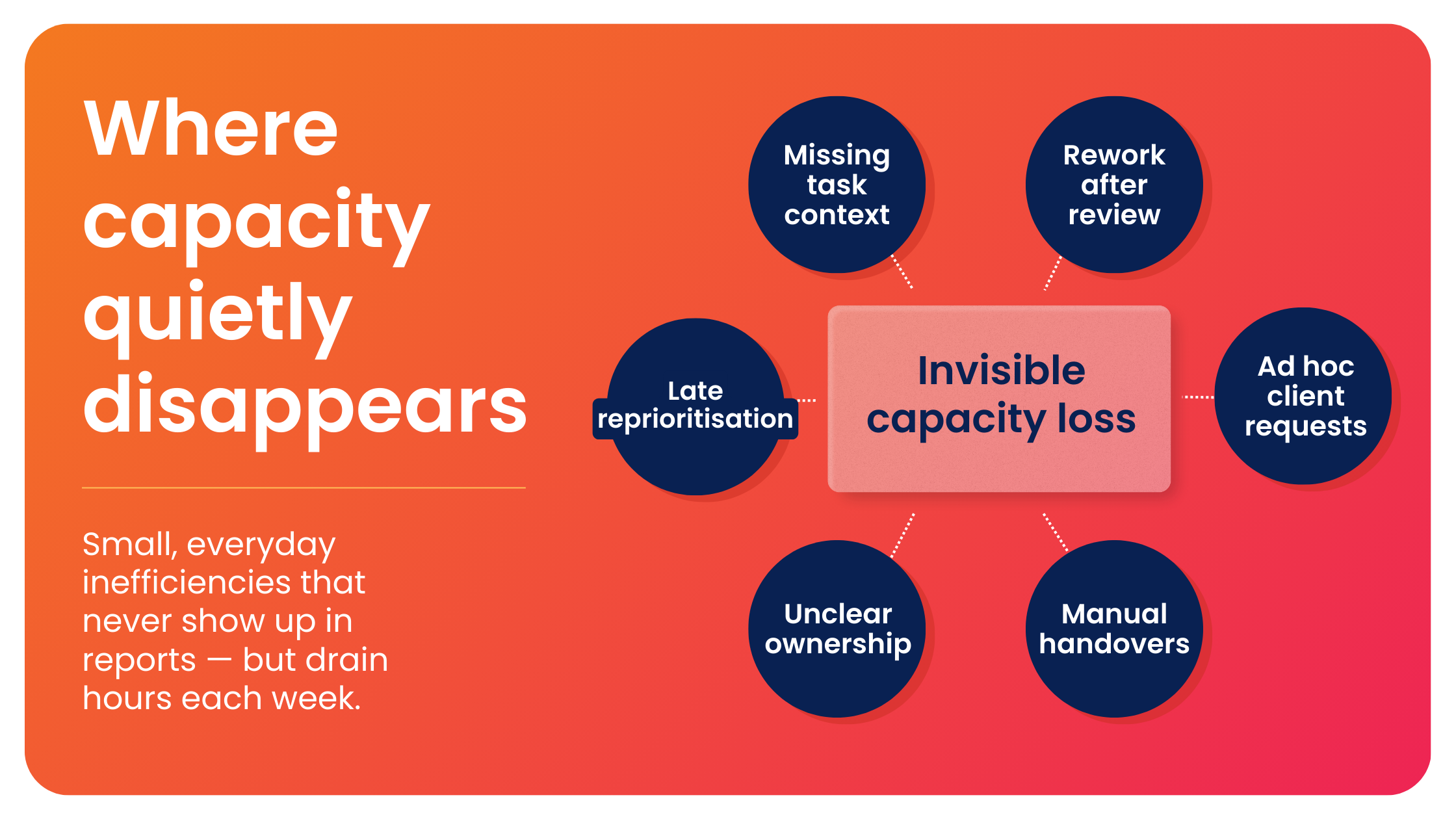
Invisible capacity loss shows up in everyday moments that feel routine inside a firm.
A senior accountant starts each morning answering a stream of clarification questions because task instructions live in last month’s email thread. A reviewer reopens work that was already completed because context was not attached to the task. A manager reshuffles deadlines late on Thursday after realising two people were already overloaded earlier in the week. A team member stays back to finish work because an ad hoc client request displaced planned tasks without being tracked.
None of this appears in a utilisation report. None of it triggers an alert. Yet across a week, it absorbs hours of effort.
When these patterns repeat, teams work harder without gaining momentum. Leaders feel reactive even when plans exist. Capacity shrinks, not because people are idle or inefficient, but because the system allows time to leak away unnoticed.
Firms that address this problem do not start by asking their teams to push harder. They start by making capacity visible.
Why CAS firms feel the pressure earlier than most
CAS firms operate inside a unique delivery model. Work is recurring, deadline-driven, and often layered with advisory services that vary in effort month to month. This creates several structural pressures that accelerate capacity loss.
Client growth outpaces operational structure
As firms add clients, task volume increases immediately. Without a parallel improvement in workflow visibility and ownership, teams absorb the additional work informally. Capacity tightens long before headcount changes.
Seasonal demand compresses timelines
Tax season, year-end close, and regulatory reporting periods concentrate work into narrow windows. Small delays earlier in the cycle surface later as intense pressure.
Ad hoc work disrupts planned capacity
Client requests that fall outside defined workflows often receive priority attention. Over time, this work displaces scheduled tasks and introduces uncertainty into delivery planning.
Distributed teams rely on shared visibility
Remote and hybrid teams depend on systems to replace informal check-ins. When that visibility is missing, leaders often discover capacity issues after deadlines slip.
These conditions exist in most growing CAS firms. The difference between firms that struggle and firms that stabilise lies in how early they can see capacity strain and respond.
One firm leader described the shift clearly after implementing Levvy:
“My capacity has been freed up, I think 50% or more.”
— Saruul Altantuya, ArtSmart
That relief came from visibility, not from adding hours.
How Levvy supports clearer capacity decisions
Levvy was designed around a simple principle. When teams can see work clearly, they make better decisions faster.
Rather than treating capacity as an abstract planning exercise, Levvy brings real-time visibility into how work is actually flowing through the firm. Leaders see workload distribution, time investment, and availability in one place. Teams understand what they own, what is next, and where attention is needed.
This shared clarity changes daily behaviour across the firm.
The tools that surface real capacity
Real-time capacity insights
Levvy shows live availability and utilisation across the team as work progresses. Leaders can filter by employee, client, service, or cost per hour. This view highlights pressure points early, allowing teams to rebalance work before deadlines are affected.
Automated time tracking
Task-level time data captures how long work actually takes across workflows. Planning conversations become grounded in evidence. Forecasting and billing reviews draw from consistent data rather than estimates.
Bulk task reassignment
When someone is unavailable, Levvy allows managers to reassign workloads quickly. Tasks move without creating bottlenecks elsewhere, and delivery continues smoothly.
Custom availability settings
Part-time schedules, seasonal staff, and flexible arrangements are reflected accurately in planning views. Capacity forecasts align with real working patterns.
Resource allocation optimisation
Live data highlights emerging bottlenecks. Teams adjust workloads during the week rather than compensating late in the cycle. Utilisation remains steady across the firm.
Together, these tools create a single, reliable view of capacity that supports consistent decision-making.
One firm leader captured the impact of this visibility:
“The aha for me was the capacity and budgeting tracking. Seeing cost per hour by employee and client changed how we plan work.”
— Samantha Hallburn, PBS Accounting & Tax Solutions
A 90-day framework firms use to reset capacity
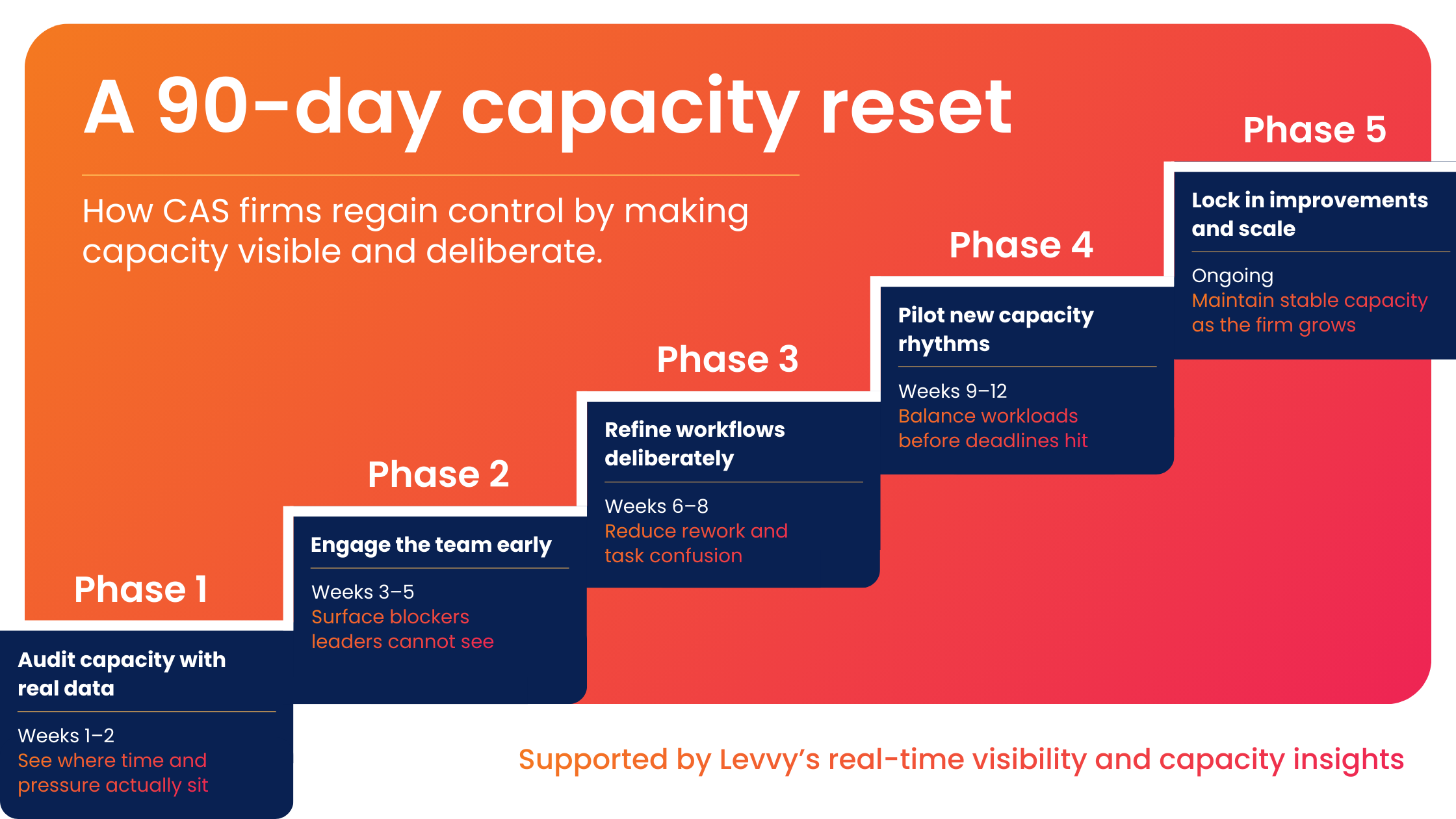
CAS firms that regain control over capacity tend to follow a similar path. They focus first on understanding the current state, then involve the team, and finally refine workflows in manageable steps.
Phase 1: Audit capacity with real data (Weeks 1–2)
The first step involves creating a clear baseline. Using Levvy dashboards and time reports, firms examine where time is spent and where pressure accumulates.
Key questions include:
- Which roles carry the highest load?
- Which clients consistently require more effort?
- Where do tasks slow down or stall?
This phase replaces assumptions with clarity and sets the foundation for change.
Phase 2: Engage the team early (Weeks 3–5)
Team members experience capacity strain firsthand. Their input reveals friction points that data alone may not show.
Firms use short surveys and asynchronous feedback to identify:
- Workflow blockers
- Repetitive administrative tasks
- Gaps in task ownership or handoffs
Early involvement strengthens insight quality and builds alignment around improvements.
Phase 3: Refine workflows deliberately (Weeks 6–8)
With visibility and feedback in hand, firms standardise core workflows using Levvy templates. Onboarding, compliance, and monthly reporting processes receive particular attention.
Clear task sequences, embedded instructions, and defined ownership reduce rework and cognitive load. Automation removes repetitive steps where appropriate.
Phase 4: Pilot new capacity rhythms (Weeks 9–12)
One team pilots the refined structure. Tasks, updates, and context remain centralised. Weekly reviews focus on flow and capacity rather than firefighting.
Levvy supports rapid adjustments during this phase, allowing teams to fine-tune processes without disrupting client delivery.
Phase 5: Lock in improvements and scale (Week 12+)
Firms review results using Levvy analytics, tracking:
- Capacity stability
- Turnaround times
- Overtime patterns
Across firms, the same pattern emerges. Clearer capacity leads to steadier delivery, faster turnaround, and reduced pressure on teams.
Another firm leader noted:
“Levvy cut our ad hoc task delays by at least 60%.”
— Ashley Klein, Bookkeeping Repair
What firms experience after the reset
The impact of clearer capacity management extends beyond schedules and dashboards. Teams report smoother weeks, fewer last-minute escalations, and a stronger sense of control over their work.
Leaders gain confidence in planning decisions. Clients receive more consistent delivery. Teams finish weeks knowing what is complete and what comes next.
These results reflect a broader shift toward operational maturity built on visibility and structure.
Capacity as a foundation for sustainable growth
As CAS firms plan for the years ahead, growth depends less on headcount expansion and more on how effectively capacity is managed.
Firms that invest in visibility protect margins, support team wellbeing, and create room for advisory work. Clear capacity allows leaders to make deliberate decisions rather than reactive ones.
Levvy supports this approach by giving firms a shared view of work, time, and availability. With that foundation in place, teams move through busy periods with greater confidence and control.
Whether preparing for tax season or planning the next phase of growth, Levvy provides the structure needed to keep capacity visible and work moving predictably.
Start your free trial of Levvy today.
Gain clear visibility into capacity, balance workloads with confidence, and support your team before pressure builds.
.png)
.png)